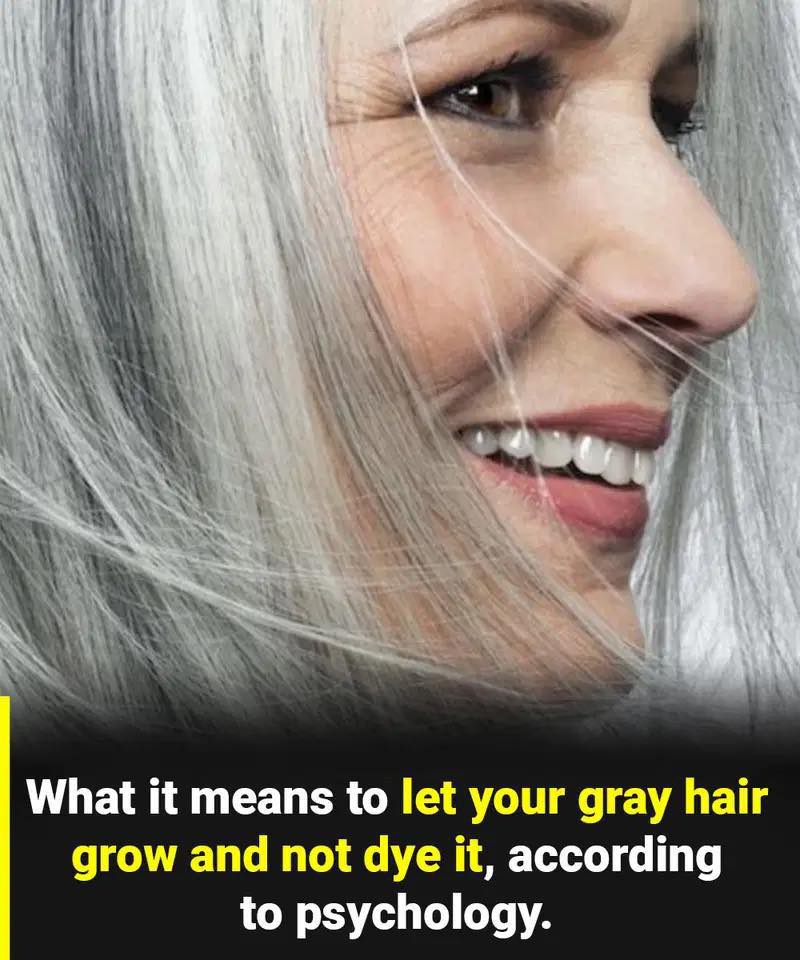
Letting gray hair grow out naturally—without dye or disguise—is a choice more and more people are making. What once was seen as a symbol of aging, loss of youth, and declining social value has evolved into something radically different: a bold expression of self-acceptance, authenticity, and emotional strength.
This shift isn’t superficial—it signals a deeper transformation in how we relate to our appearance, our identity, and the societal pressures around us.
From Stigma to Strength
For decades, gray hair was widely perceived as a flaw to be corrected—a visible marker of age that needed to be hidden, especially for women. Coloring it wasn’t just a beauty choice, but often a social expectation tied to staying relevant, attractive, and “youthful.”
But the tide is turning.
According to psychologists, choosing to let gray hair show is often part of a larger personal evolution—a process that involves rejecting outdated beliefs about age and embracing oneself more fully. Hair, after all, plays a powerful role in how we present ourselves to the world. When someone decides to stop dyeing it, they’re often also choosing to redefine their identity on their own terms.
A Silent Act of Self-Affirmation
From a psychological lens, going gray naturally can be a form of self-affirmation—a quiet but powerful way of saying:
“This is me. I’m not hiding.”
It’s not about giving up; it’s about letting go—of shame, of pretense, of the belief that looking younger equals being more valuable. And while this pressure has historically fallen harder on women, men too are increasingly expected to dye away the years to stay “competitive” or “fresh.”
In this light, embracing gray becomes a liberating act—not of surrender, but of freedom.
Gray Hair as a Sign of Psychological Maturity :
Discover more
Spa treatments relaxation rejuvenation
Hair confidence books
Hair coloring
Hair coloring options dyes
Gray hair care products
Beauty Confidence workshop
Hair growth supplements
Hair accessories scarves clips
Anti aging skincare products
Dye
Many who make the switch describe the experience as deeply relieving. It ends the cycle of constant upkeep and worry about “roots” showing, and allows energy to be directed toward things that matter more—relationships, goals, self-care.
Psychologists often interpret this as a sign of emotional maturity: the understanding that one’s value isn’t tied to surface-level beauty, but to experience, confidence, and inner alignment.
In that sense, going gray can feel less like a loss and more like a homecoming—to a version of the self that no longer needs to chase external validation.
A Cultural Shift with Social Impact
But this isn’t just a personal journey—it’s a collective one, too.
From a social psychology perspective, when more people publicly challenge stereotypes (in this case, that gray hair equals decline), they create space for others to do the same. The growing visibility of natural gray hair in media, fashion, and public life signals a broader cultural evolution—a movement toward redefining beauty on more inclusive, empowering terms.
It can even become an act of quiet resistance: pushing back against the obsession with eternal youth and perfection that’s long dominated mainstream aesthetics.
Emotional Honesty & Self-Congruence
One powerful psychological benefit that experts highlight is emotional congruence—the sense that your outer appearance reflects your inner reality.
Choosing not to hide gray hair communicates emotional honesty:
“I don’t need to pretend I’m younger than I am. I’m enough as I am.”
This kind of transparency often leads to deeper, more authentic relationships, as the individual no longer presents a filtered version of themselves to the world. That alignment between inner truth and outer appearance can significantly boost self-esteem and overall well-being.
see continuation on next page 2